Older Does Not Mean Unsafe, but It Adds Unknowns
An older Ann Arbor home may have steep roof planes, original drainage details, later additions, porch roofs, and inside corners. The gutter itself may have been repaired or replaced at a different time from the fascia behind it. These are reasons to inspect carefully, not reasons to assume failure.
DIY cleaning can be reasonable on a stable, reachable single-story section. It becomes a poor plan when access requires improvisation, when the gutter is loose, or when the task expands onto the roof. Use the checklist to make the stopping decision before equipment is raised.
Survey From the Ground
Walk around the building in dry daylight. Identify eave height, roof pitch, additions, porch transitions, overhead wires, doors, walks, landscaping, and sloped soil. Look for pulled sections, visible plants, disconnected downspouts, and places where a ladder would interfere with normal movement.
Observe rain only from a protected ground position. Note whether water spills near one outlet, behind the gutter, or across a longer run. The location helps define the task without asking you to climb in wet conditions.
Inspect the Ladder and Footing
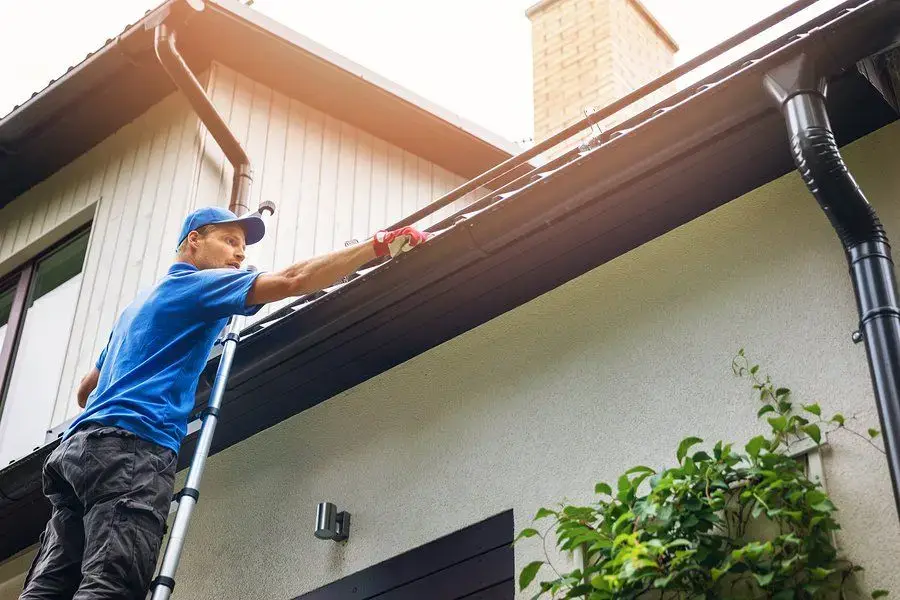
Use a ladder intended for the needed height and follow its instructions. Check rails, feet, locks, rungs, and hardware before use. Place it on firm, level, dry ground. Loose blocks, landscape stones, and improvised shims do not create reliable footing.
Keep the ladder away from electrical conductors and do not position it where a door can open into it. Never lean it against the gutter. Older metal may be loose, thin, or attached to fascia that cannot safely accept that force.
Have Another Person Present
A helper can keep the area clear, stabilize according to the equipment guidance, and respond if the situation changes. Agree on how tools and debris will be managed. Climbing while carrying awkward containers reduces control; use a method suited to the ladder and task.
Children, pets, and pedestrians should remain outside the work zone. Wet leaves dropped onto a walk create a slipping hazard even when the ladder setup itself is stable.
Protect Against Hidden Debris
Gutter material can contain sharp fragments, insects, decayed organic matter, and fasteners hidden beneath leaves. Wear suitable gloves and eye protection. Do not reach blindly into a downspout opening or behind a guard.
Remove material in small sections and keep your body centered between the rails. Descend and move the ladder rather than stretching sideways. Start away from the outlet so debris is not packed into the downspout as you work.
Treat Roof Access as a Separate Decision
A porch roof may look like a convenient platform, but walking it introduces surface condition, slope, edge, and material risks. Wet shingles and loose debris reduce traction. Older roof surfaces may also be vulnerable to concentrated foot traffic.
If the job requires stepping from a ladder onto the roof, reaching across a valley, or working beside a steep plane, stop. Professional access is appropriate because of the setup, even if the gutter contents are ordinary.
Watch for Fragile Existing Conditions
A pulled gutter, soft-looking fascia, open seam, or displaced downspout should not be used as a handhold. Cleaning may expose the defect, but it will not restore support. Avoid applying force that could enlarge it.
After debris removal, standing water can indicate pitch or a low section. Leakage at a dry, clean joint may call for gutter repair. Do not add sealant over wet residue as a substitute for identifying the condition.
Stop for Weather and Winter
Wind, rain, soft ground, frost, and ice are stop conditions. Frozen gutters should not be struck, heated with flame, or flooded with very hot water. Falling ice and sudden runoff add hazards below while the eave remains difficult above.
Wait for thaw and dry access. If winter water is entering the building or creates another urgent risk, contact the appropriate emergency or building professional rather than improvising roof work.
Complete Ground-Level Checks
Once the channel is open, inspect reachable downspout connections and extensions. Confirm that lower pieces are not crushed and that discharge continues away from the foundation without crossing a walk. This part of the route is often safer to correct from the ground.
Use a Clear Go-or-Stop Test
Proceed only when the section is low and reachable, the equipment is sound, footing is stable, conditions are dry, another person is present, and the task does not require roof access or overreaching. If any of those statements is false, postpone or request help.
Our broader DIY gutter cleaning guide explains the same framework for other rooflines. For a free professional cleaning quote, call (734) 838-4946 and describe the access constraints as carefully as the debris.